
Sometimes we need to change the form of a quadratic depending on what the situation is. One way of taking a general quadratic and rewriting it in vector form, is to “complete the square”. Learn about what this means and work through some examples to further your understanding.
You may also like

About WordPress
raisemymarks.com
22 Plugin Updates
00 Comments in moderation
New
SEOEnter a focus keyphrase to calculate the SEO score
Caching
Insights
WPForms
0No new files uploaded
Howdy, RaiseMyMarks
Log Out
Add new exercise
Edit with Elementor
Save Draft
Preview(opens in a new tab)
Publish…
Add title
Domain of a function
Learn what the “domain” of a function is. Learn how to identify the domain of a function and how to write the domain of a function out.
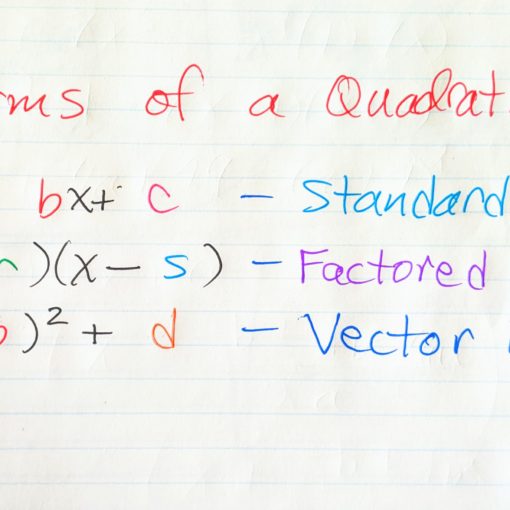
A quadratic is a polynomial of degree 2. There are different forms to represent this second degree polynomial: standard form, factored form and vector form. Depending on a particular problem, a different form will be more or less advantageous to use.

Polynomials are introduced by considering the basic building blocks of a polynomial, a monomial. From here we introduce the simplest polynomial, the binomial and then the trinomial.

The length of a line is not necessarily a practical value as a line goes on for ever. The length of a line is infinite. However, the length of a line segment is of more value and is a finite value. Any time we measure how long a package is or how long our table is, we are taking the length of a line segment. Learn the formula for finding the length of a line segment when given two points in either 2 dimensions or in 3 dimensions.