

Learn about what the “range” of a function is, how to identify the range for a function and how to write out the range of a function.
curriculum: Grade 10
53 posts
About WordPress
raisemymarks.com
22 Plugin Updates
00 Comments in moderation
New
SEOEnter a focus keyphrase to calculate the SEO score
Caching
Insights
WPForms
0No new files uploaded
Howdy, RaiseMyMarks
Log Out
Add new exercise
Edit with Elementor
Save Draft
Preview(opens in a new tab)
Publish…
Add title
Domain of a function
Learn what the “domain” of a function is. Learn how to identify the domain of a function and how to write the domain of a function out.
Sometimes we need to change the form of a quadratic depending on what the situation is. One way of taking a general quadratic and rewriting it in vector form, is to “complete the square”. Learn about what this means and work through some examples to further your understanding.

Learn what x-intercepts and what y-intercepts of a function are. Learn how to locate the x and y intercepts of a function.
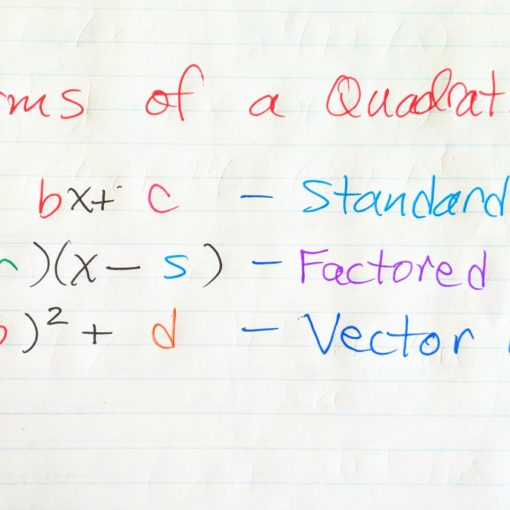
A quadratic is a polynomial of degree 2. There are different forms to represent this second degree polynomial: standard form, factored form and vector form. Depending on a particular problem, a different form will be more or less advantageous to use.
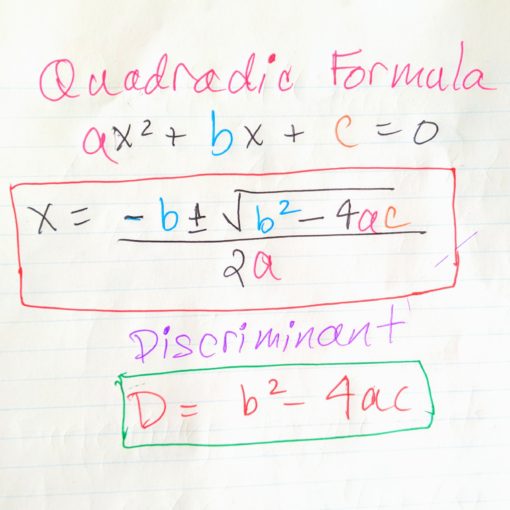
When we are faced with a quadratic that is not “nice” to factor we need to find a way to factor it. This is where the quadratic formula comes in. The discriminant is a value that can be calculated for each quadratic equation. Depending on the value of the discriminant, we can determine if the quadratic equation has a solution, or has factors, or not.

Quadratics are polynomials of degree 2. These polynomials have some interesting properties. There are quadratics with special structures such as perfect squares and differences of squares. Many quadratics can be factors and we will be looking at how to factor different quadratics. Here we are introducing you to quadratics and how to factor “nice” quadratics.